










Comparison of Effectiveness Between Conventional Scouring & Bio-Scouring On Cotton Fabrics
Link to the Article in Google Scholar
Interaction of Some Properties among Yarns and Jersey, Rib, and Interlock Knit Fabrics
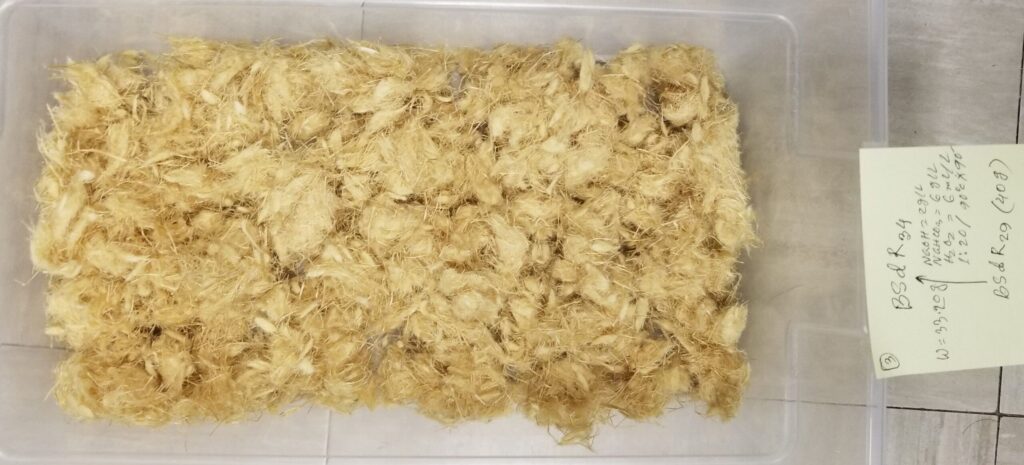
An experimental study toward eco-friendly bamboo fiber extraction for textiles
Link of the Thesis to ProQuest
Production of Ecofriendly Natural Bamboo Bast Fiber and Assessment of Antibacterial Activity
Production of natural bamboo fibers-1: experimental approaches to different processes and analyses
Production of natural bamboo fiber—2: Assessment and comparison of antibacterial activity
Link to AATCC Journal of Research
Production of Natural Bamboo Fibers-3: SEM and EDX Analyses of Structures and Properties
Link to AATCC Journal of Research
Investigation of the Exraction Processes and Performance Properties of Kudzu Fibers
Production, modification, and characterization of natural bamboo fiber
Link of the Dissertation to ProQUest
Interaction of the Qualities and Properties between Yarns and Fabrics
How is Vague Language Being Used in Retail Websites for Bamboo Viscose Products?
Link to Sustainability in Fashion
Production and modification of natural bamboo fibers from four bamboo species, and their prospects in textile manufacturing
Modified Techniques to Detect Antibacterial Activity of Bamboo and Natural Bamboo Fiber
Characterization of the crystallographic properties of bamboo plants, natural and viscose fibers by X-ray diffraction method
Link to The Journal of The Textile Institute
Analyses of the chemical compositions and structures of four bamboo species and their natural fibers by infrared, laser, and X-ray spectroscopies
Investigation and comparison of antibacterial property of bamboo plants, natural bamboo fibers and commercial bamboo viscose textiles
Link to The Journal of The Textile Institute
Carbide nanoparticle dispersion techniques for metal powder metallurgy
Strategies of the Online Bamboo Viscose Clothing and Textiles Retailers
Link to Current Trends in Fashion Technology & Textile Engineering
An Investigation of Charging Effects by Different Factors on Carbon and Natural Bamboo Fibers in High-Resolution Scanning Electron Microscopic Imaging
Link to Journal of Natural Fibers
Investigation of the extraction processes and performance properties of kudzu fibers
Link to Journal of Natural Fibers
Hydrogen embrittlement and mechanical response of 304L steel with ZrC additions
Abstract
While stainless steels are widely used for hydrogen storage infrastructure, they can still be vulnerable to hydrogen embrittlement justifying the need to further improve their hydrogen resiliency. Here, we investigate the potential for transition metal carbide additions to improve the hydrogen compatibility of austenitic stainless steels. ZrC nanoparticles were dispersed in contents of 0.01–10 wt% in 304 L stainless steel powder, mixed via high energy ball milling, and subsequently consolidated using direct current sintering. To assess hydrogen compatibility, the tensile properties of similarly processed 304 L without ZrC nanoparticles were compared to 304 L with the ZrC additions; both materials were evaluated prior to and after hydrogen exposure (non-charged and H-precharged, respectively). Depending upon the ZrC phase fraction, the yield strengths varied from ∼325 to 560 MPa in the non-charged condition and from ∼375 to 550 MPa in the H-precharged condition. Strain at failure varied from ∼5 to 90 % and from ∼5 to 35 % in the non-charged and hydrogen-precharged conditions, respectively. Results from stress-strain profiles demonstrate limited efficacy of ZrC as a method to mitigate hydrogen embrittlement entirely but does demonstrate the potency of ZrC inclusions as strengthening addition to 304 L alloys without a loss of ductility.
